Sunday, 16 October 2011

Looking at the Back muscles!

Ok Back Muscles, very complicated at first. But again with the help of landmarks it can be easily laid out. Latissiumus Dorsi (attatchments: origin, from the Spinious process of the six last thoracic vertebrae and all the lumbar vertebrae: from the sacral vertebrae; from the iliac tuberosity; from posterior third of the iliac crest) is a thin muscle that covers quite a big section of the back. However when the body is articulated other muscles such as the Serratus Anterior/interior the spinal erectors which are big clumps of muscle that look like think columns at the base of your back.

First look at the Deltoids, which form the big bulk at the top of the arm: Attachments origin, from the clavicle (lateral third of the anterior border) from the scapula and its external border of the acromion all attaching to the Humerus. Another example of the clavicle being a big landmark to place.


Above is the Trapezius, it attaches to several landmarks, being the Seventh cervical vertebrae, Clavicle (Acromion process) and finally the medial border of the Scapula.


In these two images the Scapula Section of the Deltoid (labelled 6 for image above and 1 for image to the left) it shows that the muscles tendon that travels back to the scapula. In this space there wouldn't be any deformation as the tenders don't contract so it key when placing these muscles I think about the tendons as these will be mostly flat areas.


Torso

Now time for Ecorches over the real reference and art work from the ages. The Torso is a very interesting section to work with and I feel I have learnt loads from developing the idea of the landmarks as its a great bases for the placement of the rest of the muscles.

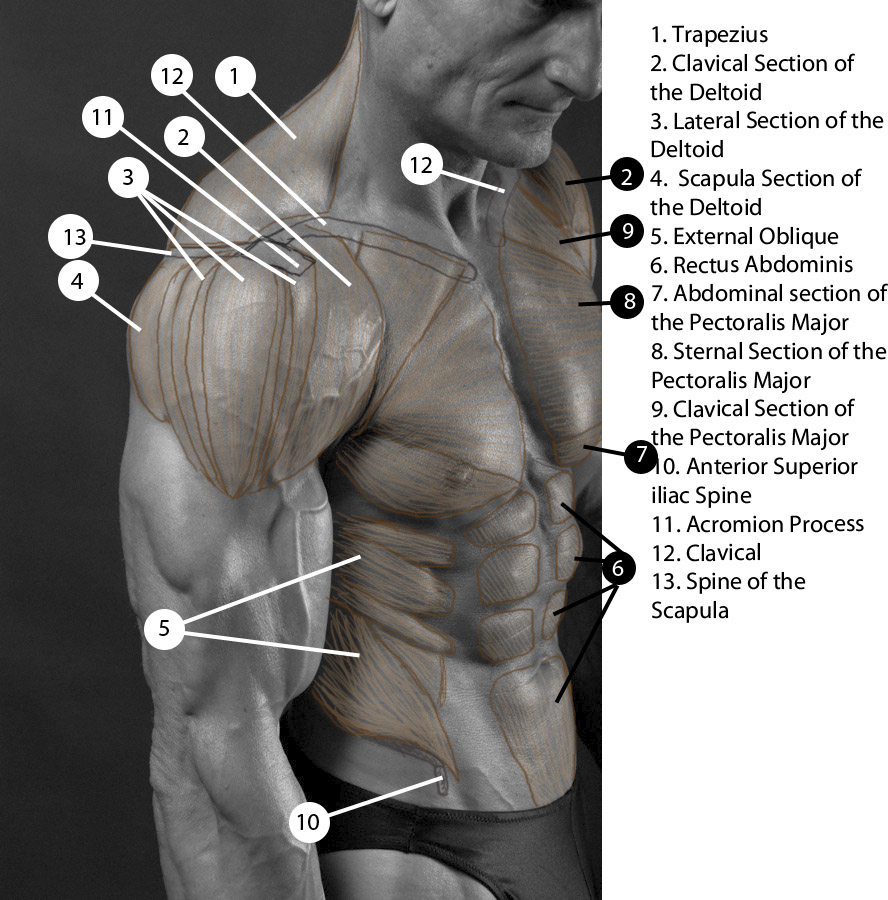
Here you can see the quite noticeable digitation of my favourite muscle so far the Serratus Anterior (origin, from the first eight or nine ribs, Lateral Surface. Insertion, into the spinal border of the Scapula). You can see where it intersects with the External Obliques.


Again Art work shows the amazing knowledge artist knew over 200 years ago. The Pectoralis is well placed in these two images and show the place where the three heads interact with each other near the arm pit, where the muscles create obvious surface deformation.


Torso: Research

For this bit of research I drew over the skeletal images from the book. I wanted to break dow the torso and understand the placements of each muscle as for example the Pectoralis muscle is made up of three different heads that all start from different areas of the rib cage and land on different areas of the Humerus. First head derives from the Clavicle and attaches lowest down on the Humerus of the three. Second is the sternal section that attaches in the middle, with the third section of the muscle that attaches to the Abdominal Fasiciuli. These sections overlap and intercept eachother. I will show the result that this causes over real reference.


The Abdominal Muscles are a very interesting set of muscles. The Rectus Abdominis is attaches on the fifth rib with the External Oblique attaching to a big long tenderise sheet called the Abdominal Fasiciuli which go underneath the Rectus Abdominis.


Here are some great images from the ages that show the construction of the torso. Da Vinci shows the construction well of the Pectoralis muscles.


Thursday, 13 October 2011

Skeleton: LandMarks

For development I labelled a Skeleton with all the Landmarks of the body that I would need to identify and use when sculpting figure.


The Scapula is a landmark of the back that has the several muscles that attach to it as well as another land mark which is a square shape indent on your shoulder called the Acromion Process.


Here I have identified the Landmarks on a real human reference. This is something I plan to do through my research is to draw over images and draw diagrams to develop my knowledge before I get into sculpting segments of the body.


Also I will do it over Art work/Sculptures that were done centuries ago and by some of the best known artist like Da Vinci and Michael angelo and show they they knew what they were doing when they constructed their works.


Skeleton: Research


Here are diagrams I been looking at the landmarks of the skeleton that are visible on the surface of the skin. The idea of this is that give us a starting point to base out models on. The sksleton has areas around thr body that give deformation that is noticable on the skin, these are key areas for modellers as areas of topology and where to start sculpting. These diagrams were a way for me to try memories what I have been learning from the books. I took the images from the book that were just on the skeleton and drawn over in red the area that you see on most human bodies. Some of them do vary from individuals depending sometimes on gender and weight. But even with these differences, ther land marks will always be there as they are skeletal landmarks that everyone has.


To the right shows the landmarks for the Legs. The key Areas that I found out that are key placements are the Head of the Fibula and the Medial surface of the Tibia. Getting these aswel as the Patella would set up most of the leg muscle placements and proportions.

The Greater Trochanter was a very interesting bone for me as it shows the angled bone called the Femur. That along with one of the main landmarks of the body. The Anterior Superior Ilia Spine which for me is the most important landmark along with the Clavical. You would measure the person you want to use as reference to get the placement and distant between the each side of the iliac crest to get the right width and depth of the body.


The Ulnar Furrow is a very key placement for me also for the arm as the extensors are the laterial side of the bone with the Flexiors that flex the fingers are on the medial side so there is a difinative line between the two and you can see this on your own arm.


Scott Eaton: Anatomy & Form

Someone that Looks into Anatomy for Figure Sculpting and VFX is an Artist called Scott Eaton (http://www.scott-eaton.com/). I have had the change to learn from him and work with him on a Feature that is due to release next year.

Here are some of his work that show the use of Anatomy and Form, both in human and Creatures models.

The model to the right is of Scotts sculpt based on the Greek myth Prometheus. He started off drawing the poses and developing the look of the sculpt before he got into 3D.

After I spoke to him about this sculpt and see his lecture. I learnt about the importance of research and reference. As he drew loads of concepts and had a solid idea. Also the development of the muscles start off with the idea of landmarks and blocking in muscles start from lower subdivisions.

Below shows a tutorial that he made called "The Archer", here he gave a quick insight on creating human form and developing a pose.


Also you see an example of an ecorche and how this can help you use reference to more of an exercise as well as critiquing your own drawings or Sculpts.


Below shows how Scott takes anatomy and applies it to creatures and concept art to give it that more belivable and he knows about Animal anatomy as well as again animals and creature design is becoming a big thing in the industry so knowing how to develop a realistic anatomy structure behind the model only strengthens the concept.

The image of his Centaur is a great example of taking that knowlege and creating a unique but realistic design. Creating this model he took into mind the proportions of the horse with the human part of the body as if the horse part is too big, would the spine able to take the wait? or again with the human part was to big. would he be able to stand up without falling over.
Also he thought about how the abdomin of the human would merge with the horse so he had to think about new landmarks and how would the skeleton would work.

To the left is how to bend what you know. This is an example of Scotts idea of a Frankenstein style character. He has taken the idea of many different humans being sown together and played with the proportions and muscle deformations but still keeping the structure for it to seem real.



Books Resources


Below are images showing the two books I have found & will use to learn about Anatomy and ideas on how to improve on my knowledge such as different techniques I could use to develop with.

First book is "Figure Drawing: Design and Invention" by Michael Hampton. This book is about getting form and Anatomy in your drawings. The idea is breaking down the figure into shapes and to start of simple by capturing the form, contours and deformation muscles and bones create on the surface.

I can use this book as a great start to maybe start to develop my own drawings before I get into 3D, so I can already develop a pose with basic structure before I get modelling.


Also the taking the idea of drawings further and into more a technical way, these images show to develop the idea of placements of muscles and bones with drawings, even in 3D this can be done. 

I have learnt about Landmarks, which are boney placements you see on the surface on the skin. These are a way to start developing your muscles as you can start to sculpt from the landmarks as you know what muscles start where based on them.

The two images show this well how this is useful because you can see what muscles will move where when the arm is moved/raised. The bottom image shows this well and the muscles all based off of the Clavicle (collar bone) and how the peck muscles attach to the arm.

I will be using this book more to try develop my own breakdowns and how to look at my sculpts/drawings in a more technical way.


The Artistic Anatomy by Dr Paul Richer as most likely been the best reference book I have ever bought! it has everything I am learning and using as reference for the bones, landmarks and muscle insertion points.

Sorry about the poor images but alot of the points and information I will give about the body will be from this book!